Monday, August 11, 2014
DACA and the Dream Act
This video looks at DACA and the Dream Act from a New York State perspective but really lays out a lot of the issues that students face across the country. It helps the viewer understand how this a global issue and that after a K-12 education students have many barriers to cross. There are lesson plans and a resource guide to the short film.

Thursday, August 7, 2014
Immigration in the Classroom: Preparing for the Topic Over the Summer
 As a
classroom teacher, administrator or community member you play a critical
role in the development of youth beyond the classroom. As
the educational landscape evolves, your understanding of important
issues, like immigration, is important to the success of your students
and your community. As educators you naturally connect with youth,
parents and community members and have unique opportunities to discuss
the civic, social, psychological, educational and economic effects of
immigration as a community.
Most
recently you have probably heard about Deferred Action for Childhood
Arrivals (DACA) and the humanitarian crisis on the border involving the
migration of unaccompanied youth increasingly coming across our Southern
border. The American Immigration
Council has a plethora of resources that will help you get up-to-speed
on the topic and to answer important questions or lead you to the
correct resources in your communities. From early childhood to young
adulthood we have resources that can help you navigate this complicated
topic.
As a
former classroom teacher, I know how valuable summertime is for rest and
relaxation, but the reality is a true teacher never really stops their
professional development and their constant intellectual curiosity - so
that’s why I wanted to share some easy resources for you to look at that
will hopefully help you better understand these complicated issues,
that affect so many of your students and community members.
Resources, like a Q&A guide about DACA or a recent report Two Years and Counting
about the impact DACA has had over the past two years, can provide
answers you need to discuss these topics in your classroom or community.
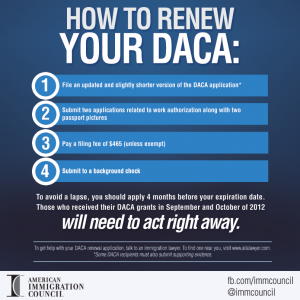
The American Immigration Council's blog ImmigrationImpact .com has timely analysis on each day’s most pressing immigration topics, like this story
which discusses family separation and how records show that in 2013
over 70 thousand deportees reported having at least one U.S. born child.
Our classroom resources include book reviews and lesson plans that help to get the discussion started. Books like Sonia Nazario’s Enrique’s Journey can be read by High School students and a newer version is suitable for a younger audience and stories like From North to South
by Rene Colato Lainez can be read in English or Spanish and discusses
deportation and family separation in a way students as young as 6 or 7
can understand. Visit the Council's book reviews for more ideas and let us know which are your favorites.
Claire Tesh
Friday, February 7, 2014
Math+Immigration=Learning
 Teaching Math with Immigration:
Using infographics not only helps students understand an issue visually, but really puts math facts into perspective. Look at this great piece from the Learning Network to get started. Looking at a pie-chart is often easier than just hearing a percentage. Immigration facts are full of big numbers and to understand the big picture have your students watch the following video "Our Future Together by Center for American Progress.
The site for "Our Future Together also has a great interactive activity that lends itself well to many creative math lessons.

If you are short on time and still want to use immigration related infographics don't forget about our State Fact sheets. You can pull all kinds of quick lessons and great discussions from the state facts.
Scholastic has a more elementary graph showing immigration trends. The American Immigration Council has a lesson for elementary students that enables them to design their own graphs by collecting immigration stories from their peers.
Let us know how you teach immigration through math teacher@immcouncil.org.
Tuesday, October 8, 2013
DACA Resources
 NEA and an ally organization created a resource that helps answer questions about DACA eligibility and how to apply.
Deferred Action for Childhood Arrivals (“DACA”) is a memorandum passed on June 15, 2012. It was implemented by the Secretary of the Department Homeland Security. It directs U.S. Customs and Border Protection (CBP), U.S. Citizenship and Immigration Services (USCIS), and U.S. Immigration and Customs Enforcement (ICE) to practice prosecutorial discretion towards some individuals who immigrated illegally to the United States as children.
A grant of deferred removal action does not confer lawful immigration status, alter an individual’s existing immigration status, or provide a path to citizenship.
A Washington Post report looks at the past year and where the applicants come from. The infographic paints a picture that shows where DACA applicants were born, and where they live now
DACA applicants were born in 192 countries. While individuals from Mexico make up the majority of applicants in most states, states along the East Coast have a more diverse composition. These maps show the percentage breakdown of applicants in each state, by the region where the individual was born.
According to the Brookings Institute, 537,000 young people have been accepted into the DACA program since last August.
Many say that the program is working for some and not working for others. For example in this ABC news report from Houston yesterday, some young people are having trouble getting simple documentation from their country of birth. In this case an honor student can not get a copy of his birth certificate from the Mexican government thus throwing his opportunity to get deferred action and continue his higher ed studies into limbo.
Monday, October 7, 2013
Immigration and Entrepreneurship
 Teaching students about immigration by giving them a better understanding of the contributions of entrepeneurs and innovators throughout U.S. history gives students a better foundation of the economics of immigration and debunks many myths about immigrants not contributing to our economy. Immigrants invent, they innovate, they open businesses and they create jobs. In a blog post by the American Immigration Council they lay out the most recent findings and measure the impact of immigrant owned enterprises.
According to Entrepeneur Magazine a new survey offers more evidence of immigrants' contributions to the U.S. entrepreneur ecosystem and overall economic health. A report from bipartisan immigration reform group the Partnership for a New American Economy found that immigrants are two times as likely to start a business than their native-born peers. Also, immigrants started 28 percent of new businesses in 2011, according to the August 2012 report, far exceeding the 12.9 percent of the population they represent. They are job creators, too. One in 10 employees of U.S. privately-owned companies work at an immigrant-owned business and those businesses contribute more than $775 billion to the U.S. economy, the report says.
Read more: http://www.entrepreneur.com/article/226273#ixzz2h8i5yTuh
Immigrant entrepreneurs and innovators have a common thread they overcame many barriers and succeeded beyond most expectations. Read more: http://www.entrepreneur.com/article/226273#ixzz2h8i5yTuh
Organizing for Action recently published an immigrant story on Convo's founder, Faizan Buzdar (Convo is a Facebook for enterprises). Faizan shares his difficulty of waiting to get a visa - and the accompanying uncertainty and confusion. If the immigration system was more straightforward, he could have spent all this time and energy building his startup, which could have grown to support additional American jobs. See the video below and start a discussion in your classroom.
Additional resources:
Tina Seelig an amazing professor at Stanford University discusses concepts of immigrant entrepreneurs in her series of talks-The Art of Teaching Entrepreneurship and Innovation
The Immigration Policy Center- Entrepreneur Innovation Newsletter
Author Richard Herman provocativly looks at the remarkable contributions of high-skill immigrant entrepreneurs in America. Both a revelation and a call-to-action, Immigrant, Inc. explores the uncommon skill and drive of America's new immigrants and their knack for innovation and entrepreneurship. From the techies who created icons of the new economy-Intel, Google, eBay and Sun Microsystems-to the young engineers tinkering with solar power and next-generation car batteries, immigrants have proven themselves to be America's competitive advantage...
Subscribe to:
Posts (Atom)